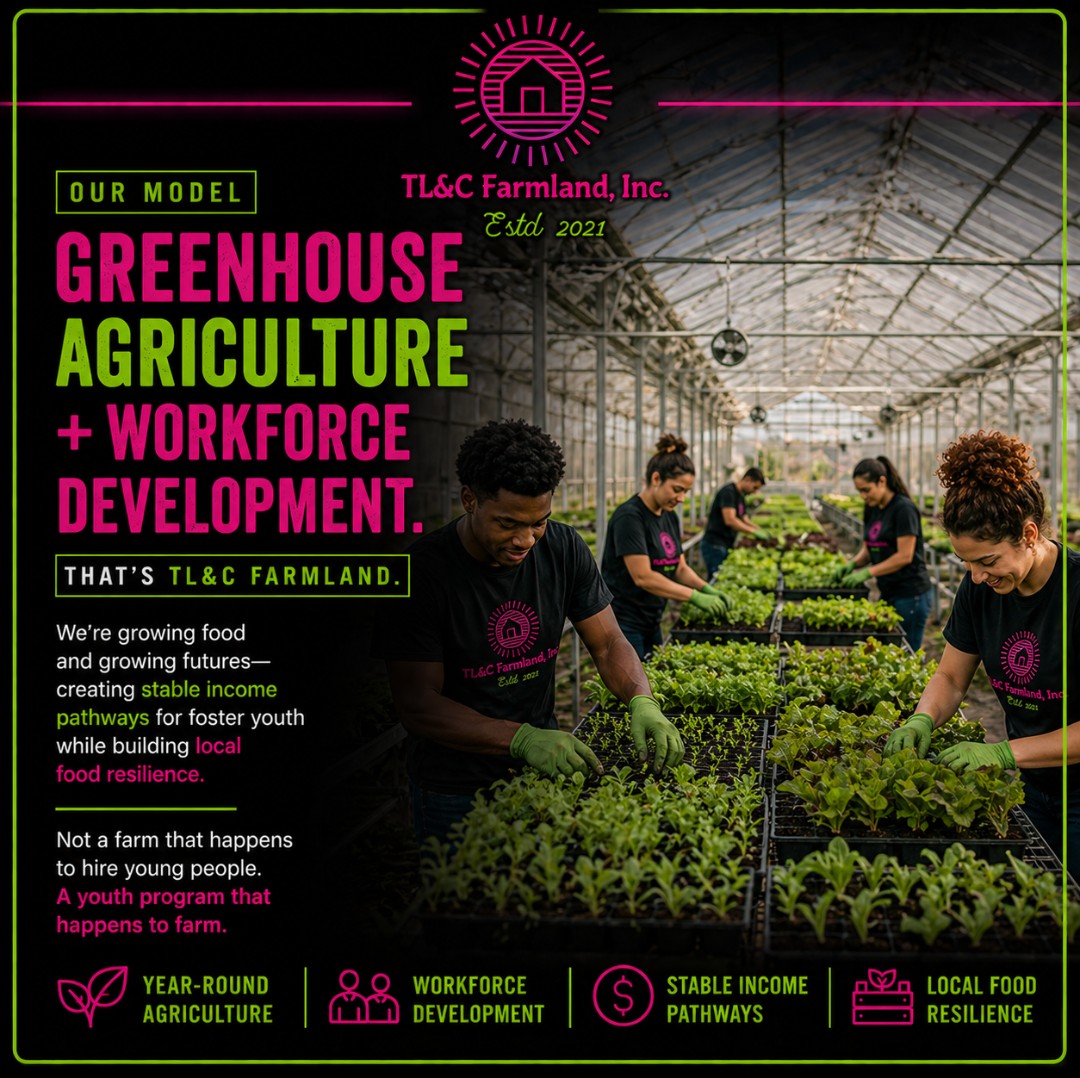
TL&C Farmland is being built as a residential farm-based support model designed around the real needs of youth aging out of foster care: housing stability, workforce training, wellness support, life skills, and long-term community.
Housing comes first. Youth can’t learn, heal, or grow when they don’t know where they’re sleeping. TL&C Farmland is in prelaunch and is working toward safe, stable residential housing on a working farm site.
Unlike emergency shelters or group homes that feel institutional, our residential model is built around community. Youth live alongside peers, share meals grown on the farm, and wake up with purpose every day.
Transplanting, direct seeding, herbs & greens
Peak harvest, farmers market sales, tomatoes & peppers
Root vegetables, cover crops, soil prep
Year-round greenhouse production & aquaponics
Youth will not simply observe farm work—they will be trained to manage greenhouse tasks, tend crops, and learn produce operations from seed to sale. The planned model uses greenhouse and aquaponics systems to support year-round learning, food production, and paid work opportunities.
Sustainable agriculture is a transferable skill. Youth leave with real agrarian knowledge they can apply in farming, food business, or environmental careers.
Real independence requires skills the system never taught. TL&C Farmland uses a 4-level progression model—Seedling, Sprout, Harvest, Root—so youth advance through real milestones, not arbitrary timelines.
Safety, stability, and the basics of life on the farm.
Take ownership of a greenhouse section and build employment skills.
Lead farm operations, mentor newer residents, and explore career paths.
Exit with housing, income, savings, and a network that doesn’t disappear.
Fifty percent of foster youth are unemployed at age 24. TL&C Farmland attacks that statistic directly. The goal is to connect residents with paid farm-based work, job experience, and income-building opportunities as the program develops.
As residents progress through the levels, they take on greater responsibility and greater pay. By the time they leave, they have job history, references, and a savings account.
Paid work begins immediately. Every shift counts toward a real employment record.
Structured coaching turns farm work into marketable credentials employers recognize.
Job placement support and internship matching in the local area.
Graduates leave with a real savings account and a financial head start.
Clinical approach designed for youth who’ve experienced systemic trauma, loss, and instability.
More advanced residents mentor newer youth. Shared experience builds real connection.
Research-backed: growing things heals. Hands in soil, daily purpose, and tangible results.
Counseling is embedded in the program—not an add-on. Begins at Level 1.
Eighty percent of foster youth experience significant mental health challenges. You cannot teach life skills to a young person who is in survival mode. TL&C Farmland prioritizes healing as a prerequisite to everything else.
Our trauma-informed model doesn’t treat mental health as a separate program component—it’s woven into how we structure the day, how staff interact with residents, and how the entire farm community operates.
Graduation from TL&C Farmland doesn’t mean the relationship ends. Foster youth are uniquely vulnerable in the years after they leave structured support—so we stay in contact, stay available, and stay connected.
Support continues through age 24. Alumni have access to emergency resources, mentorship, job connections, and a community of people who know them by name—not by a case number.
Full residential support, daily structure, paid work, counseling
Weekly check-ins, emergency access, housing and job support
Monthly check-ins, alumni network, career referrals
On-demand support, community events, option to return as mentor
Digital downloads built from real work on our farm — every purchase supports TL&C Farmland's youth agriculture program.
The questions prospective families most often ask about TL&C Farmland's residential youth program.
Youth ages 16–24, with priority on those aging out of foster care. Younger siblings or family members of current residents may also be considered once the program is fully operational — we’ll publish full referral criteria on the Youth Referral page when intake opens.
Nothing. Housing, meals, agricultural training, life-skills programming, mental-health support, and stipends for farm work are fully covered for residents through grants, donations, and earned revenue from farm operations. Families don’t pay tuition or fees.
The site is being finalized in the prelaunch phase — the location is “Site TBD” pending land, licensing guidance, and funding. The model is residential: youth live on a working farm in private and semi-private rooms with shared common areas, at a planned capacity of 10–20 residents at a time.
Mornings begin with shared farm chores; mid-day rotates between greenhouse and aquaponics training, classroom time (GED prep, financial literacy, career coaching), and paid farm work. Evenings include shared meals grown on-site, peer mentorship across the 4-level progression (Seedling → Sprout → Harvest → Root), and structured downtime. Weekends include farmers market sales, off-site recreation, and community visits. Because the farm produces 365 days a year, learning is year-round — no off-season.
Planned 24/7 on-site staff trained in trauma-informed care, structured peer mentorship across program levels, clinical mental-health support integrated from Level 1, and small resident cohorts (10–20) so every youth is known by name — not a case number. Site licensing will follow state youth residential standards as it is finalized during prelaunch.
Don’t see your question? Reach out.
A look inside the planned youth agricultural vocational program — the four pillars we teach, what a residential week actually looks like on the farm, and what graduates walk away with.
The foundation of every working farm. Residents learn to grow food from seed to harvest in soil and greenhouse systems.
Daily routines with livestock and poultry build responsibility, observation skills, and confidence around living things.
Turning harvest into shelf-stable food that lasts year-round — a real skill with deep cultural and economic value.
The skills that turn a working farm into a livelihood — planning, sales, finances, and customer relationships.
Mornings begin with shared farm chores; mid-day rotates between greenhouse and aquaponics training, classroom time, and paid farm work. Evenings include shared meals grown on-site, peer mentorship across the 4-level progression, and structured reflection. Weekends include farmers market sales and off-site community time.
Anchored on Soil & Plant Systems for the bulk of the working hours, but every pillar shows up before lights-out. Here’s a real Tuesday, wake-up to quiet hours — the lesson, the hands-on, the chore rotation, and the reflection prompt at each block. Days like this are why intake matters — get notified when doors open.
Residents don’t just spend time on the farm — they finish with concrete skills, a real capstone project, and a portfolio that translates farm hours into career capital.
Hands-on competency in planting, animal care, food preservation, equipment use, food safety, and CSA or market sales.
Each resident designs and runs a season-long farm enterprise — a market garden, a livestock rotation, a value-added product line — from plan to harvest to sales.
A documented record of farm hours, skills earned, references, and the capstone write-up — ready to show employers, schools, or lenders.
TL&C Farmland is led by a real human with deep roots in agriculture — and an on-farm instructional team being assembled right now during prelaunch. Here’s who runs the program and the pillars they’ll teach.
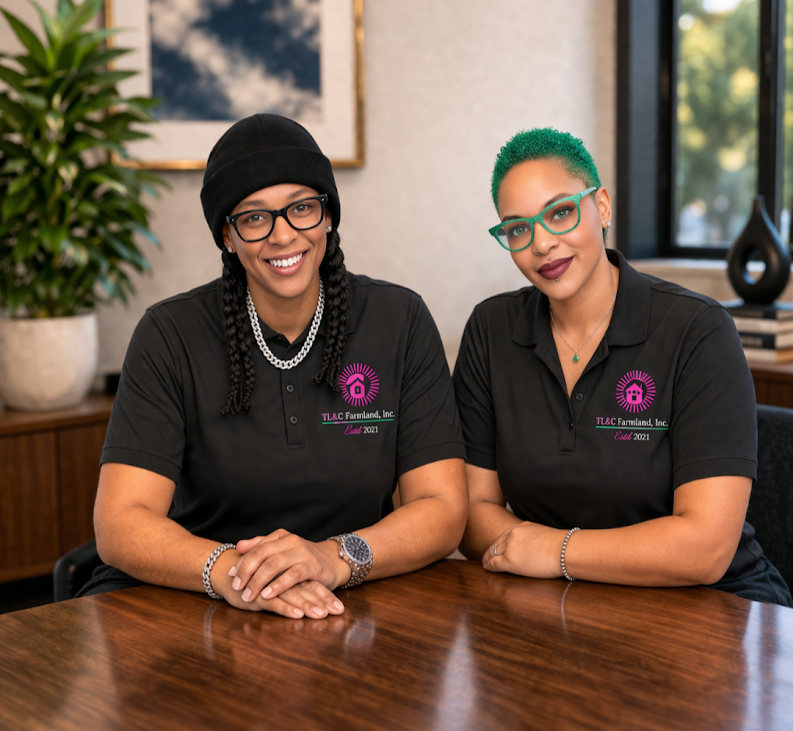
Twakenna grew up in the country, where she fell in love with agriculture—growing fresh vegetables in the garden right at home. That early connection to the land never left her. She went on to build a multidisciplinary background spanning Business Administration, Healthcare, and Information Technology—skills she now channels into every layer of TL&C Farmland’s operations, from program design to financial sustainability.
contact@tlcfarmlandinc.orgInstructor to be announced. We’re hiring the on-farm instructors who will run Soil & Plant Systems, Animal Care, Food Preservation, and Farm Business pillars for our residential program.
TBAInstructor to be announced. We’re hiring the on-farm instructors who will run Soil & Plant Systems, Animal Care, Food Preservation, and Farm Business pillars for our residential program.
TBAOur residential agricultural youth program is launching soon. Leave your name and email — and an optional note about the prospective participant's age or preferred program timing — and we'll reach out as soon as intake begins.
Whether you can donate, volunteer, partner, or refer a young person who needs a place like this—TL&C Farmland is ready.
Get Involved →Stay in the loop.
Farm updates, volunteer days, and ways to help. No spam.
🔒 We’ll never share your info.